-
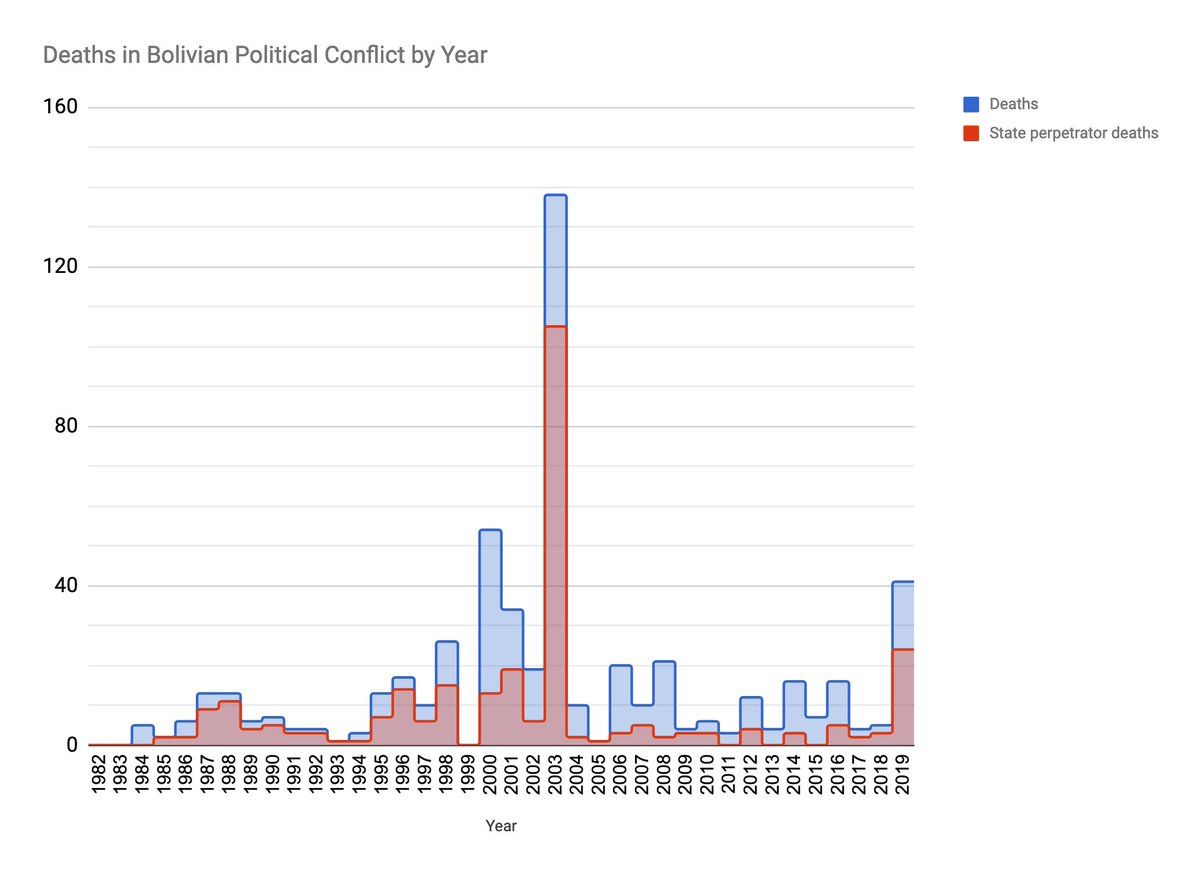
Here's what we can learn about deadly political violence during the Evo Morales administration by putting it in context of the 38 years of democracy since 1982: 1. The Morales years were a return to the low levels of state-perpetrated violence that prevailed from 1982 to 1995.Permalink On twitter.com

 ♻️ 14 Retweets
❤️ 29 Favorites
Mood -9 🙁
♻️ 14 Retweets
❤️ 29 Favorites
Mood -9 🙁
-
2. Carlos Mesa (Oct 2003-Jun 2005) and Evo Morales (Jan 2006 to Nov 2019) presided over similar levels of state and nonstate violence.Permalink On twitter.com
❤️ 2 Favorites
Mood -3 🙁
-
3. What Mesa and Morales had in common was largely keeping the military out of a policing role and negotiating with very active social movements, even when they directly opposed their rule.Permalink On twitter.com
❤️ 4 Favorites
Mood +1 🙂
-
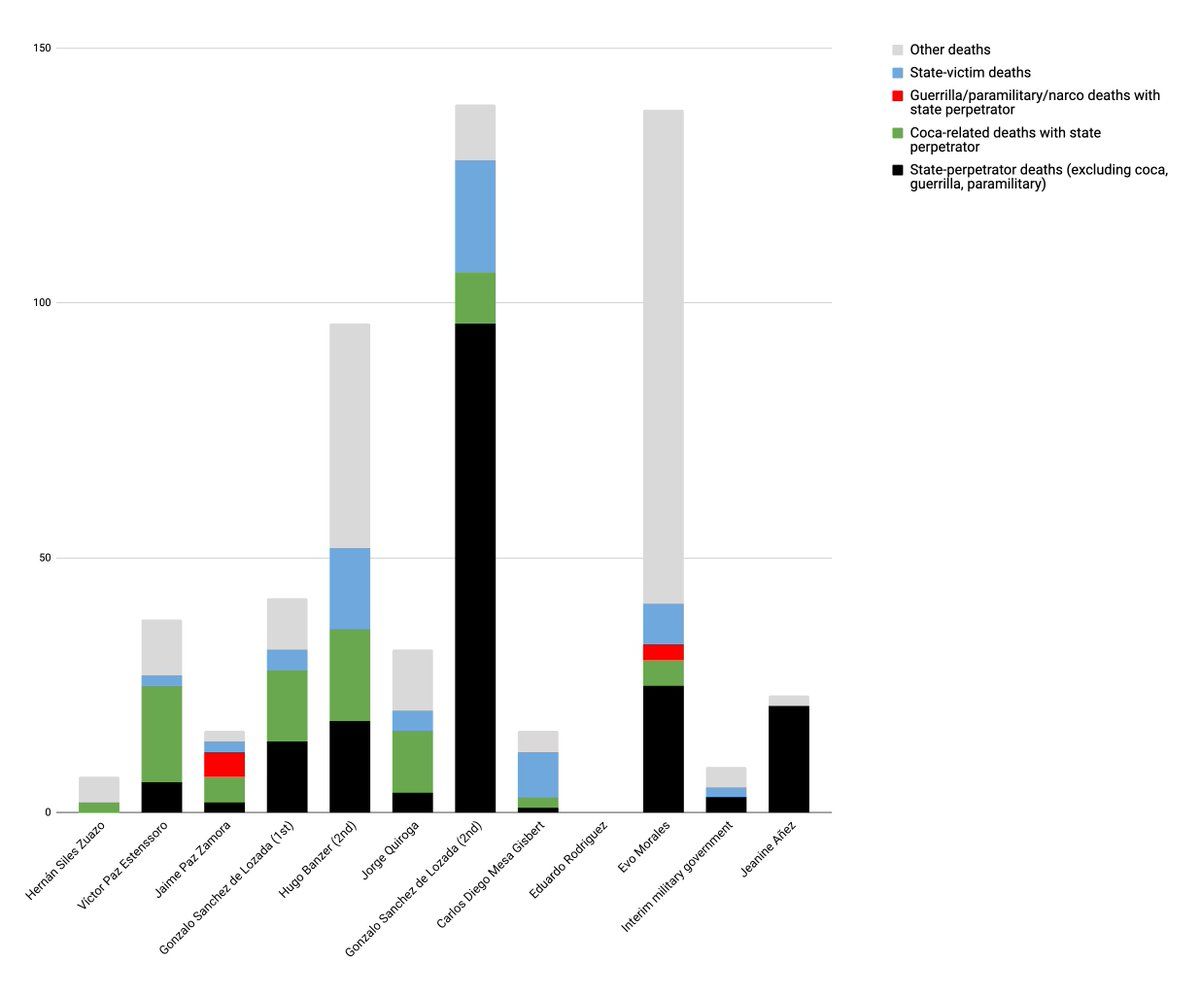
4. If we squeeze all the deaths during the Morales' 14 years into a single figure, 138, we come very close to Gonzalo Sánchez de Lozada's 14-month toll of 139, but the composition of these deaths is very different.Permalink On twitter.com
 ❤️ 1 Favorite
Mood -4 🙁
❤️ 1 Favorite
Mood -4 🙁
-
5. The key feature of this disparity is the relative prevalence of deaths in political conflict not involving the state. Again, Mesa and Morales are alike, so I've consolidated them here.Permalink On twitter.com
 ❤️ 3 Favorites
Mood -4 🙁
❤️ 3 Favorites
Mood -4 🙁
-
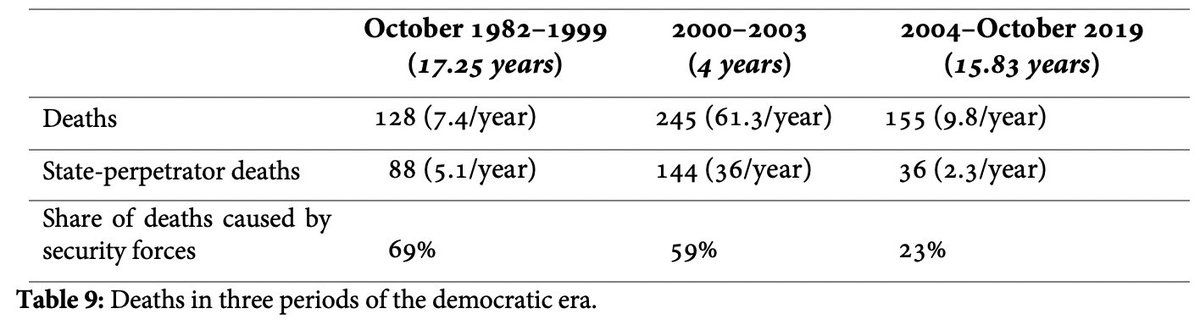
6. If we leave aside the deadly 2000-2003 period (marked by the Gas War, 2003 Tarifazo, and the peak of Laymi-Qaqachaka guerra de ayllus), we see that Morales and Mesa presided over less than half as many state-perpetrated deaths as the pre-2000 era.Permalink On twitter.com
❤️ 1 Favorite
Mood -8 🙁
-
7. On the other hand, the Mesa and Morales years saw somewhat more overall deaths per year, 9.7 and 10.0, respectively.Permalink On twitter.com
❤️ 1 Favorite
Mood -2 🙁
-
8. During this period the share of political conflict deaths caused by state security forces plummeted from a clear majority to 23%.Permalink On twitter.com
❤️ 1 Favorite
Mood -2 🙁
-
9. Part of this uptick in intra-civilian violence was partisan political conflict, which caused 26 deaths over Morales' term.Permalink On twitter.com
❤️ 1 Favorite
Mood -7 🙁
-
10. These deaths were evenly split between MAS and the opposition. Pro-MAS civilians killed 7 anti-MAS civilians and 6 municipal workers in El Alto. MAS supporters suffered 2 deaths at the hands of armed civilians in the 2007 Cochabamba clashes, and 11 at El Porvenir in 2008.Permalink On twitter.com
❤️ 1 Favorite
Mood -8 🙁
-
11. The pro-MAS violence mostly occurred late in Morales' term, including 4 deaths during the 2019 crisis. Anti-MAS civilians are credibly suspected of beating pro-MAS journalist Sebastián Moro then, likely leading to his death, but I'm not counting it in this total.On twitter.com
❤️ 1 Favorite
Mood -10 🙁
-
12. Partisan civilian conflict killed 26-27 people during the Morales term and 2 more after Evo's ouster (14 years) vs. eight deaths from 1987 to 2004, so this represents a major escalation in the deadliness of partisan conflict.Permalink On twitter.com
❤️ 4 Favorites
Mood -9 🙁
-
13. Again, more than half of these partisan conflict deaths were associated the left-right crisis of 2006-2008, which also involved deaths in state-civilian conflicts at La Calancha (3), the Cobija airport (2) and the Rosza raid (3).Permalink On twitter.com
❤️ 4 Favorites
Mood -11 🙁
-
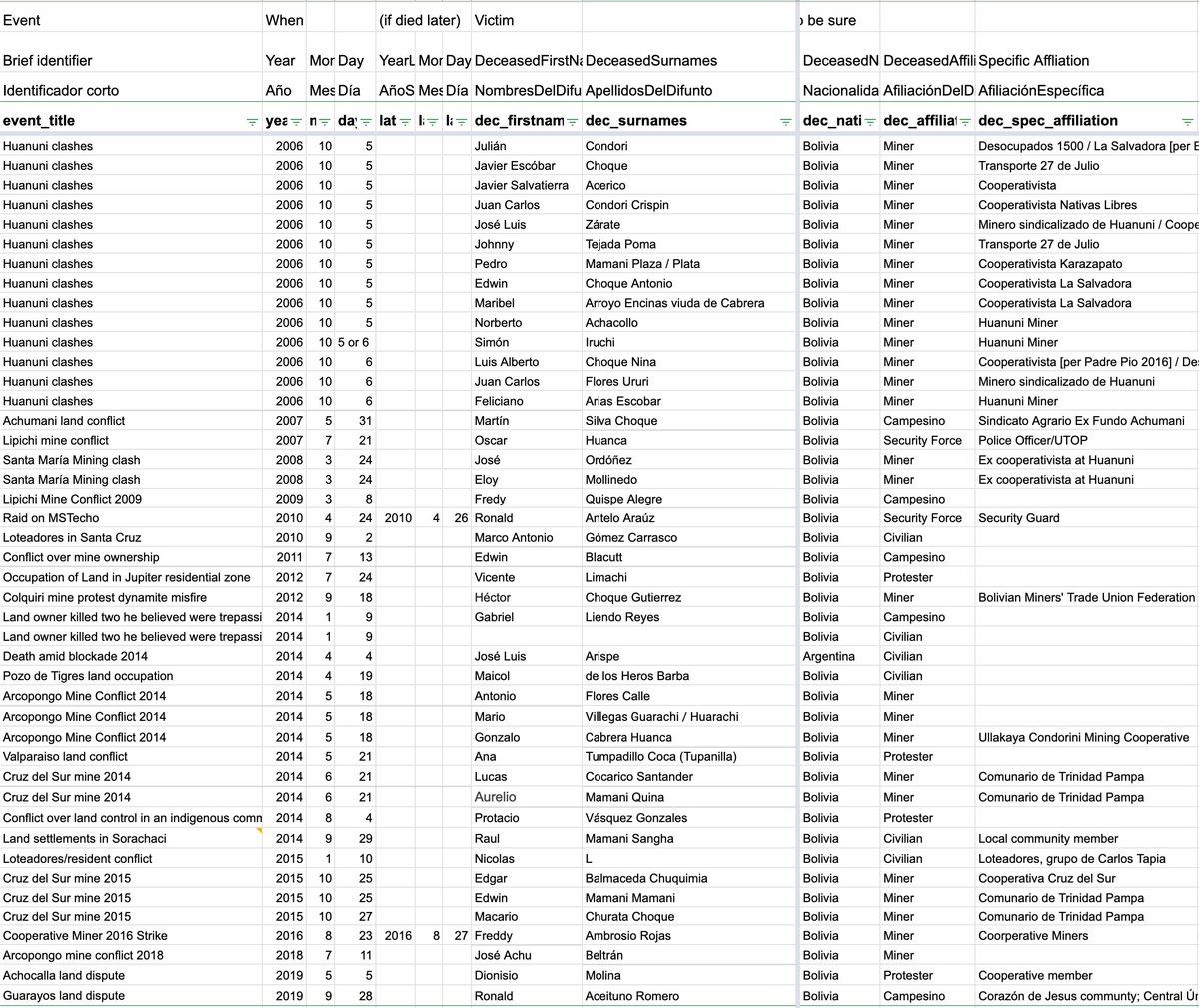
14. The bigger story of lethal violence during the Morales years is local mining and land conflicts, which claimed 45 lives in incidents not involving the state directly.Permalink On twitter.com
 ❤️ 3 Favorites
Mood -7 🙁
❤️ 3 Favorites
Mood -7 🙁
-
15. These 45 deaths are a third of all deaths during the Morales era, more than the 33 deaths perpetrated by state forces, or the 26-27 deaths in partisan conflicts.Permalink On twitter.com
❤️ 1 Favorite
Mood -12 🙁
-
Nearly all of this research is laid out in the Morales segment of my new research paper on deadly repression in Bolivia. woborders.blog/2020/05/19/research-paper-repression/Permalink On twitter.com
♻️ 3 Retweets
❤️ 6 Favorites
Mood -3 🙁