-
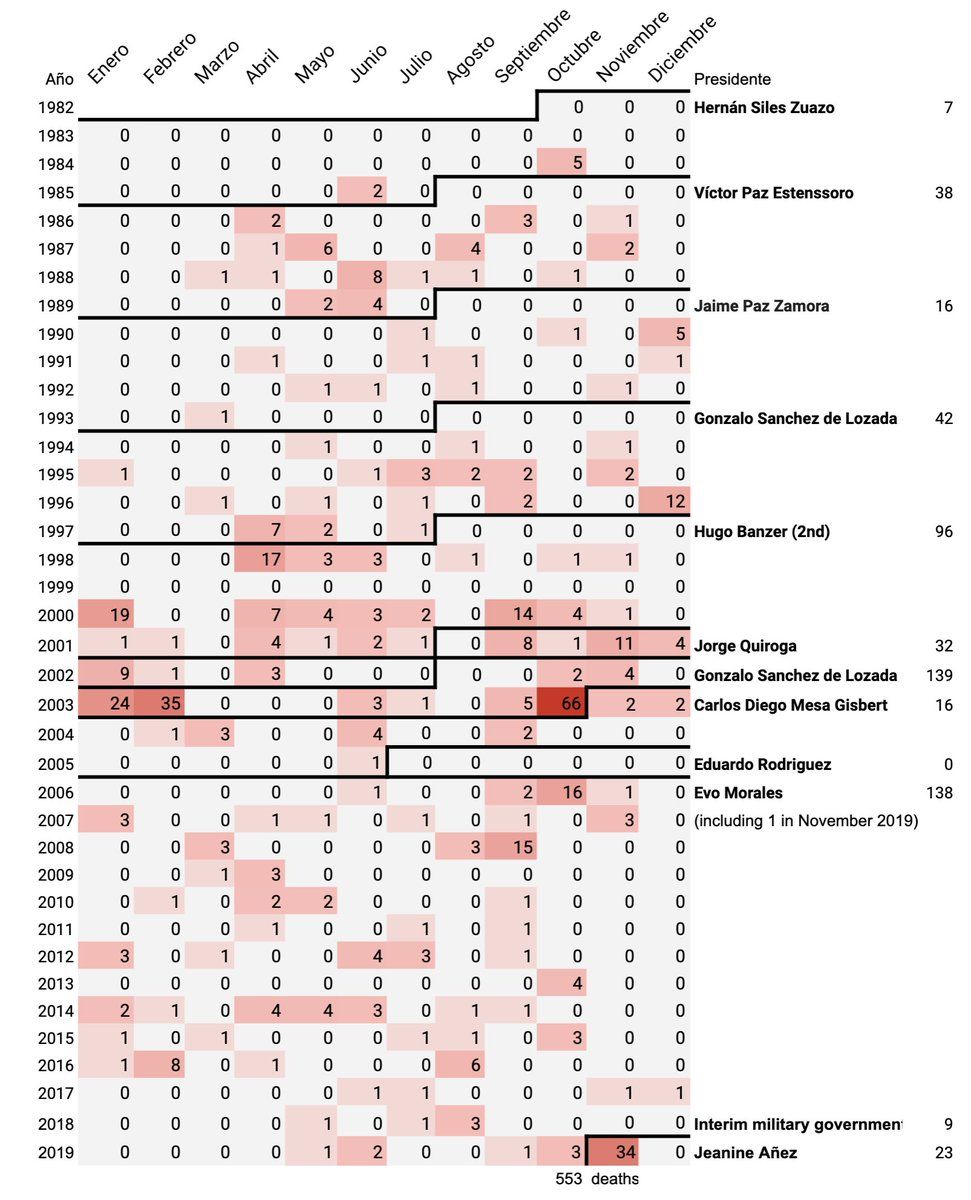
What did I learn by looking systematically at lethal violence during the 2019 Bolivian crisis? 1. November 2019 alone proved to be the bloodiest month in sixteen years, with 34 deaths, and the third deadliest month of the democratic era.Permalink On twitter.com

 ♻️ 17 Retweets
❤️ 22 Favorites
Mood -12 🙁
♻️ 17 Retweets
❤️ 22 Favorites
Mood -12 🙁
-
2. Thirty-seven people died in the 2019 crisis. 5 before Morales' ouster; all killed by civilian protesters. 9 during the two-day interregnum 23 under Jeanine Áñez, almost all killed by military & policePermalink On twitter.com
❤️ 1 Favorite
Mood -14 🙁
-
3. Claims by military commanders and Áñez that they were intervening to restore peace to the country were grotesquely inconsistent with their actions in November.Permalink On twitter.com
❤️ 4 Favorites
Mood +3 🙂
-
4. Four of the deaths were caused by civilian supporters of Evo Morales before he resigned, while one pro-Morales journalist (Argentine national Sebastián Moro) suffered a likely fatal beating.Permalink On twitter.com
❤️ 1 Favorite
Mood -8 🙁
-
These early deaths continued a pattern of increased deadly partisan violence, which claimed 26 lives during the Morales years (not counting Sebastián Moro's beating). Those (2006-2019) deaths were equally divided among supporters and opponents of Morales.Permalink On twitter.com
❤️ 1 Favorite
Mood -9 🙁
-
5. Under Evo Morales, security forces did not lethally repress the post-election protest, though police-protester confrontations occurred. The Morales government publicly disavowed the use of the military to either attack the protest movement or quell the police mutiny.Permalink On twitter.com
❤️ 2 Favorites
Mood -5 🙁
-
6. Seven civilians and two police officers died during two days of interim military rule. The Armed Forces evidently overrode and countermanded President Mesa’s January 2005 decree limiting military action against protesters.Permalink On twitter.com
❤️ 1 Favorite
Mood -5 🙁
-
7. Twenty-three civilians were killed after the swearing in of President Jeanine Áñez, all but one of them by joint military-police operations in response to protests.On twitter.com
❤️ 1 Favorite
Mood -7 🙁
-
8. The massacres at Sacaba (nine killed on November 15) and Senkata (11 killed on November 19) were the deadliest incidents of state violence since 2003, and of violence of any kind since 2008.Permalink On twitter.com
❤️ 2 Favorites
Mood -10 🙁
-
9. Overall, state security forces were responsible for at least 25, and as many as 28 deaths in the aftermath of Evo Morales’ ouster. These were all shootings except for one protester who fell into an abyss while chased by police.Permalink On twitter.com
❤️ 2 Favorites
Mood 0
-
10. In ten days, the police and military killed more protesters than they had in the final ten years of Morale’s rule (21), and nearly as many as in his entire administration (33).Permalink On twitter.com
❤️ 2 Favorites
Mood -5 🙁
-
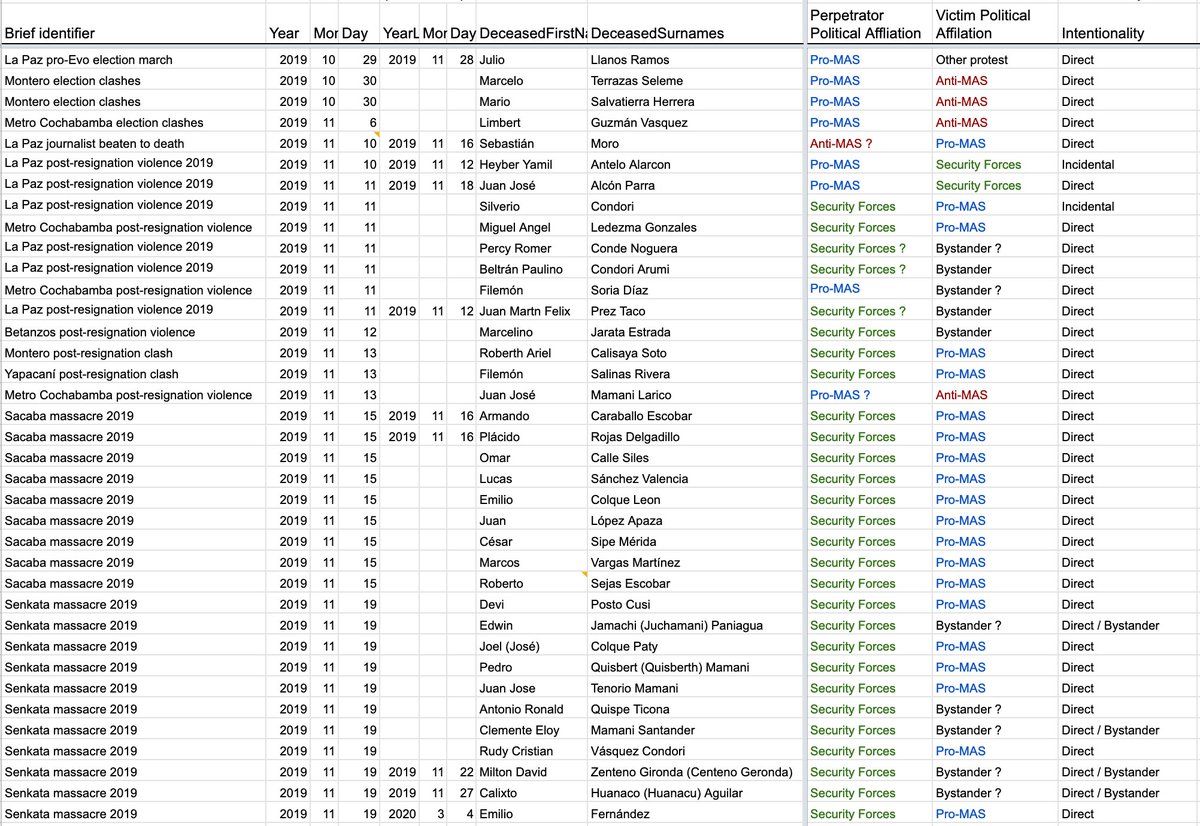
A complete list of the 37 deaths is here:Permalink On twitter.com
 ♻️ 1 Retweets
❤️ 2 Favorites
Mood -2 🙁
♻️ 1 Retweets
❤️ 2 Favorites
Mood -2 🙁
-
#BoliviaEnCrisis My new research white paper puts the 2019 Bolivian crisis in longer-term context, alongside the 2003 Gas War, which was the original subject of this research effort. hrp.law.harvard.edu/scholarship/carwil-bjork-james-explores-bolivias-2003-gas-war-and-2019-election-crisis-in-new-working-paper/Permalink On twitter.com
♻️ 5 Retweets
❤️ 13 Favorites
Mood -5 🙁